AI Personalization
Personalization is the difference between a 2% reply rate and a 15% reply rate. The question is not whether to personalize — it is how to do it at scale without sounding like a robot.
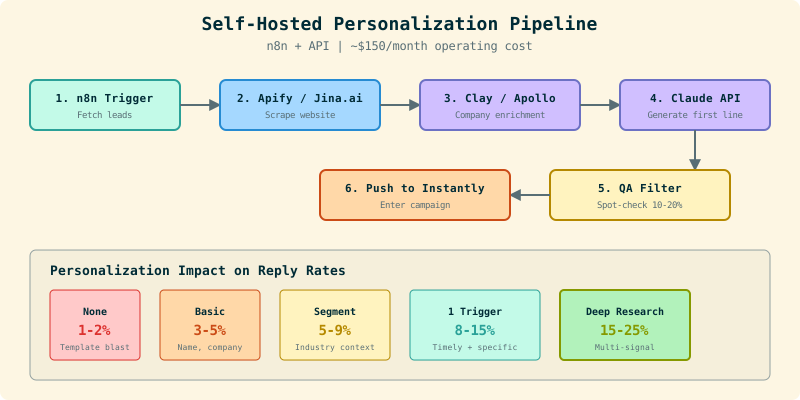
Personalization Impact on Reply Rates
The data is unambiguous. Every step up in personalization quality produces a measurable lift in reply rates. The gap between no personalization and deep multi-signal personalization is 10-15x.
Reply Rate by Personalization Depth
| Level | Approach | Reply Rate | Effort per Lead |
|---|---|---|---|
| None | Same email to everyone. Mail merge with {firstName} only. | 1-2% | 0 seconds |
| Basic | Company name, job title, industry inserted. | 3-5% | ~5 seconds |
| Segment | Different copy per ICP segment or vertical. | 5-9% | ~15 seconds |
| One trigger | Reference one recent event — funding, hire, post. | 8-15% | ~45 seconds |
| Deep multi-signal | Multiple signals woven into a narrative. | 15-25%+ | ~2 minutes |
Trigger-Based Personalization
Compliment-based openers are dead. "I was impressed by your company's growth" reads as spam because it is. Every AI tool generates the same hollow flattery. What works is referencing something recent and specific, then connecting it to a real problem your service solves.
The formula: Trigger event + implied problem + your solution.
High-Value Triggers for DevOps Prospects
- Job postings: Hiring a DevOps engineer or SRE signals infrastructure pain — they need help now, not in 3 months when the hire is ramped.
- Cloud migration signals: AWS/Azure/GCP certifications appearing in team profiles, cloud-related job posts, or migration-related blog content.
- Funding rounds: Series A-C companies have budget pressure to scale infrastructure fast. They cannot wait to build an internal team.
- New CTO/VP Engineering: New technical leaders audit and rebuild infrastructure within their first 90 days. Perfect timing for an outside partner.
- Tech stack changes: Kubernetes adoption, containerization mentions, CI/CD pipeline overhauls visible in public repos or job descriptions.
AI Tools & Cost Per Lead
The cost of AI-generated personalization has collapsed. Running your own pipeline with direct API calls costs 100-1000x less than managed personalization tools.
Personalization Cost Comparison
| Tool / Model | Cost Per Lead | Quality | Speed | Best For |
|---|---|---|---|---|
| GPT-4o-mini (API) | $0.0001 | Good | Fast | High-volume first pass, trigger extraction |
| Claude 3.5 Haiku (API) | $0.0004 | Good | Fast | Structured output, reliable formatting |
| Claude 3.5 Sonnet (API) | $0.0015 | Excellent | Moderate | Final copy generation, nuanced tone |
| GPT-4o (API) | $0.0011 | Excellent | Moderate | Complex reasoning, multi-signal synthesis |
| Clay Claygent | $0.16-1.12 | Very Good | Slow | No-code teams, built-in enrichment |
| SmartWriter | $0.15 | Good | Moderate | Standalone SaaS, no setup |
| Lyne.ai | $0.30 | Good | Moderate | Standalone SaaS, LinkedIn-focused |
| Manual (human writer) | $30-50 | Best | Slow | High-value enterprise accounts only |
Self-Hosted Personalization Pipeline
The pipeline runs entirely on n8n with API integrations. No managed AI personalization tool needed.
Prompt Engineering
The prompt is the most important piece of the pipeline. It determines whether your personalization reads as human or as obvious AI slop. Here is a battle-tested template.
You are writing the opening line of a cold email for a DevOps consultancy.

CONTEXT:
- Prospect: {name}, {title} at {company}
- Company: {company_description}
- Trigger: {trigger_event}
- Source: {trigger_source}

RULES:
1. Write ONE sentence (max 25 words) that references the trigger.
2. Connect the trigger to an infrastructure challenge they likely face.
3. Do NOT compliment them. Do NOT say "impressed" or "excited."
4. Do NOT mention your company or service.
5. Sound like a peer, not a salesperson.
6. Use specific details from the trigger — dates, names, technologies.
7. Vary sentence structure. Do NOT start with "I noticed" or "I saw."

EXAMPLES OF GOOD OPENERS:
- "Scaling to 50 engineers after your Series B usually breaks CI/CD pipelines before anything else."
- "The Kubernetes migration you posted about last week — most teams hit networking issues around month 3."
- "Hiring 3 SREs at once suggests your on-call rotation is already stretched thin."

OUTPUT: Return ONLY the opening line. No quotes, no explanation.
AI Tells to Avoid
AI-generated text has recognizable patterns. If your personalization triggers any of these, it will be mentally categorized as spam — even if the recipient does not consciously identify it as AI-written.
What Reads as Human
- Specific numbers and dates: "your Series B in March" vs "your recent funding."
- Named technologies: "migrating from Jenkins to GitHub Actions" vs "modernizing your CI/CD."
- Implied knowledge: Reference a consequence of their situation, not just the situation itself.
- Casual register: Short sentences. Dashes instead of semicolons. Starting with "So" or "Looks like."
- Asymmetric structure: Mix sentence lengths. One 5-word sentence followed by a 20-word one.