Common Failures & Self-Hosted Advantage
Most cold outbound systems fail not because the strategy is wrong, but because of predictable, avoidable mistakes. Here are the five failure modes that kill campaigns, and the self-hosting strategy that gives DevOps agencies a structural edge.
5 Common Failure Modes
1. Deliverability Collapse
Your emails start landing in spam instead of the inbox. Open rates drop below 30%, bounce rates creep above 2%, and domain reputation declines silently. By the time you notice, the damage is done -- it takes weeks to recover.
2. Bad Data Quality
Purchased or scraped email lists are full of invalid addresses, spam traps, and catch-all domains. Sending to a bad list destroys your sender reputation faster than anything else. One bad batch can poison your entire domain infrastructure.
3. AI-Generated Copy That Reads Like AI
GPT-generated emails with uniform sentence lengths, hype words ("revolutionize," "cutting-edge," "game-changing"), and surface-level personalization are immediately recognizable. Prospects delete them without reading.
4. No Follow-Up System
The data is unambiguous: 70% of salespeople never follow up after the first email, yet 80% of sales require five or more touches. A single email is not a campaign -- it is a coin flip.
5. Sending from Primary Domain
Using your company's primary domain (yourcompany.com) for cold outbound is the single riskiest mistake you can make. If that domain's reputation tanks, your entire business communication -- client emails, invoices, support -- goes to spam.
Self-Hosted vs. SaaS Cost Comparison
Self-hosting the tools that can be self-hosted saves $900-10,700+ per year. The savings compound across multiple clients.
Annual Cost: SaaS vs. Self-Hosted
| Tool | SaaS Cost/mo | Self-Hosted Cost/mo | Annual Savings |
|---|---|---|---|
| n8n | $50-800 | $5-20 | $540-9,360 |
| CRM | $20-100 | $5-15 | $180-1,020 |
| Booking (Cal.com) | $15-37 | $0-5 | $180-384 |
| Total | $85-937 | $10-40 | $900-10,764 |
What to Self-Host (and What Not To)
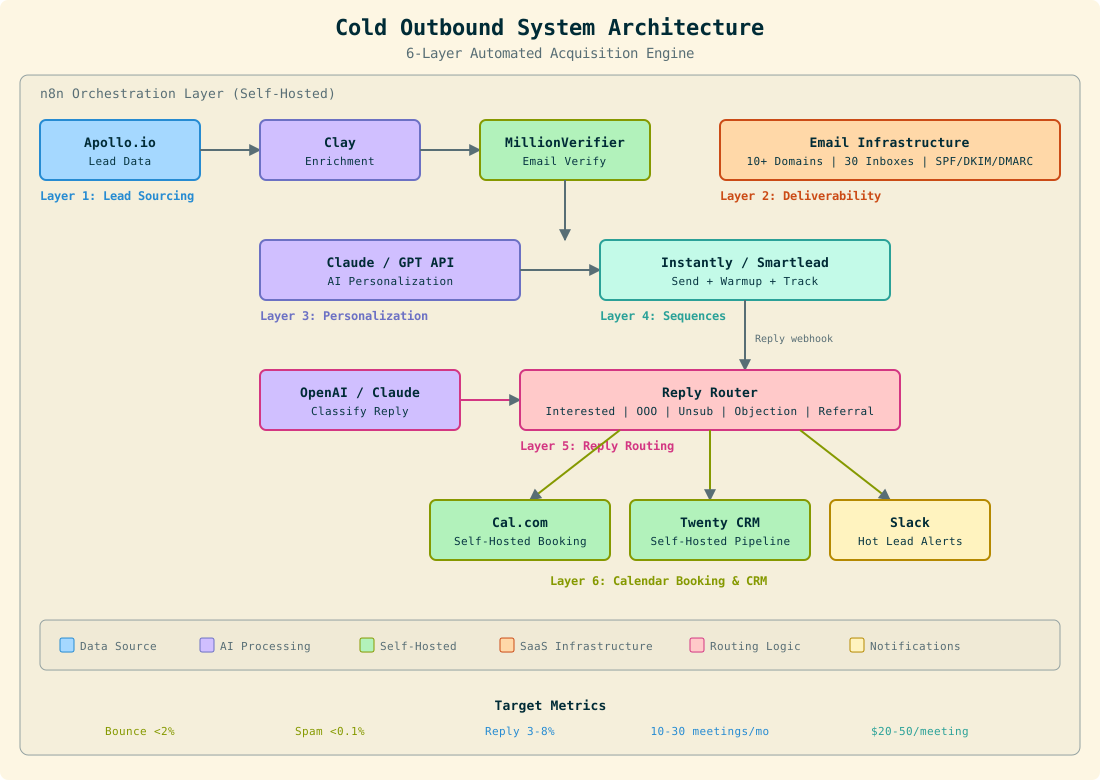
System Architecture Recap
Here is the complete system showing every tool, connection, and data flow across all six layers plus orchestration.