Sending Sequences & Follow-up
58% of replies come from the first email, but 42% come from follow-ups. A well-structured sequence turns a single touchpoint into a multi-angle conversation.
Emails in Sequence vs. Reply Rate
More emails does not always mean more replies. There is a clear plateau around email 3, and beyond 7 emails you start generating negative sentiment — unsubscribes, spam reports, and domain reputation damage.
Diminishing Returns by Sequence Length
| Emails in Sequence | Cumulative Reply Rate | Lift vs. Single Email | Notes |
|---|---|---|---|
| 1 email | ~3% (baseline) | — | Baseline. Most replies come here if the first email is strong. |
| 2 emails | ~4.8% | +60% | Significant lift. The follow-up catches people who missed email 1. |
| 3 emails | ~5.8% | +93% | Plateau begins. Still meaningful incremental gain. |
| 4-5 emails | ~7-9% | ~3x baseline | Diminishing per-email returns, but cumulative value is real. |
| 6-7 emails | ~8-10% | Marginal | Very small incremental gain per additional email. |
| 8+ emails | Net negative | — | Spam complaints rise. Domain health deteriorates. Stop here. |
The 5-Email Sequence
Each email serves a different purpose and approaches the prospect from a different angle. If they did not respond to the problem framing, try social proof. If they did not respond to social proof, try a resource. Vary the approach — do not just "bump" the same message.
Lead with the trigger-based opener. State the problem you solve in their specific context. One clear question as the CTA. No pitch, no feature list, no company history.
Under 70 wordsReference a similar company you helped — same industry, same size, same problem. Include one specific result (metric, timeline, outcome). Ask if it resonates.
40-60 wordsShare something genuinely useful — a relevant case study, benchmark data, a short teardown of their public infrastructure. Provide value without asking for anything.
50-70 wordsShortest email in the sequence. Cut everything except the ask. 'Worth a 15-minute call this week?' No re-introduction, no re-pitching, no context. Brevity signals confidence.
20-30 wordsSignal that this is the last email. Ask for a 'no' or feedback on why it was not relevant. This often produces the highest reply rate of any email in the sequence — people respond to closures.
30-50 wordsEmail Construction Rules
Cold email is not marketing email. Every element — length, formatting, timing — should make the email feel like a one-to-one message from a real person.
A/B Testing Framework
Systematic testing is the only way to improve performance over time. Without it, you are guessing. Test one variable at a time with enough volume to reach statistical significance.
Test Priority (highest impact first)
- Subject lines — Determines whether the email is opened. Test 3-5 variants per campaign launch. Largest impact on overall funnel performance.
- Opening lines — The first sentence determines whether the email is read. Test personalized vs. problem-statement openers.
- CTAs — Question vs. statement. Specific time ask vs. open-ended. "15 minutes Thursday?" vs. "Worth a conversation?"
- Email length — Test 40-word vs. 80-word variants. Shorter usually wins, but not always.
Testing Requirements
| Parameter | Requirement |
|---|---|
| Minimum contacts per variant | 250 (minimum). 500+ preferred for reliable results. |
| Confidence threshold | 95% statistical significance before declaring a winner. |
| Test duration | Run for at least 5-7 business days to account for reply lag. |
| Variables per test | One. Never test subject line and CTA simultaneously. |
Multi-Channel Amplification
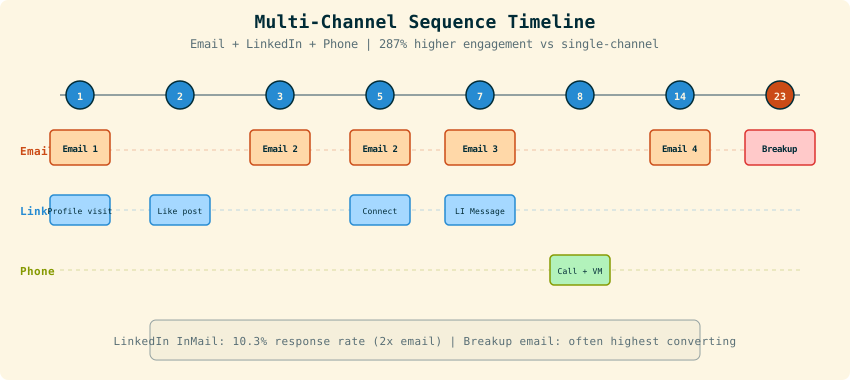
Email alone works. Email combined with LinkedIn and phone produces dramatically better results. Multi-channel sequences generate 287% higher engagement compared to email-only, and LinkedIn InMail averages a 10.3% response rate.
Day-by-Day Multi-Channel Overlay
Integrated Sequence Timeline
| Day | Phone | ||
|---|---|---|---|
| Day 0 | Email 1: Problem-first intro | — | — |
| Day 1 | — | View profile | — |
| Day 2 | — | Connect request (no note) | — |
| Day 3 | Email 2: Social proof | — | — |
| Day 5 | — | Engage with their post (like/comment) | — |
| Day 7 | Email 3: New angle/resource | — | — |
| Day 8 | — | LinkedIn DM (if connected) | — |
| Day 10 | — | — | Call attempt 1 |
| Day 14 | Email 4: Direct short ask | — | — |
| Day 17 | — | — | Call attempt 2 |
| Day 23 | Email 5: Breakup | — | — |