Lead Sourcing & List Building
The foundation of every cold outbound system. Your data quality determines your bounce rate, which determines your domain reputation, which determines whether any of your emails reach an inbox at all. Get this wrong and nothing downstream can save you.
Why Lead Sourcing Determines Everything Downstream
Cold outbound is a numbers game built on a quality foundation. The entire system — email infrastructure, AI personalization, sending sequences, reply routing, and calendar booking — depends on a single input: the quality of your prospect list.
Here is the cascade of failure when lead sourcing goes wrong:
- Bad email data (outdated, misspelled, catch-all domains) produces bounce rates above 3%.
- High bounce rates trigger spam filters at Google, Microsoft, and major ESPs.
- Triggered spam filters crater your domain reputation from day one.
- Dead domain reputation means even your perfectly personalized, genuinely valuable emails land in spam.
- Emails in spam mean zero opens, zero replies, zero meetings.
Lead sourcing is not a one-time activity. Prospect data decays at roughly 30% per year — people change jobs, companies get acquired, email systems get reconfigured. A list that was 95% accurate in January may be 65% accurate by December. Automated refresh workflows are not optional; they are a structural requirement.
This page covers the full lead sourcing stack: data providers, intent signals, automated enrichment pipelines, verification workflows, practitioner-reported accuracy numbers, and recommended tool combinations at two budget tiers.
Lead Sourcing Tool Landscape
The market has dozens of data providers. The following ten are the ones that appear most frequently in practitioner discussions, agency stacks, and cold outbound communities. No single tool is sufficient — the winning approach combines a primary data source with secondary verification and, for higher volumes, an enrichment orchestration layer.
Lead Data Providers — Head-to-Head Comparison
| Tool | Database Size | Starting Price | Email Accuracy | Best For |
|---|---|---|---|---|
| Apollo.io | 275M+ contacts | Free / $49/mo | 85-88% | All-in-one starting point |
| Clay | 150+ providers | $149/mo | 80-88% | Enrichment orchestration |
| LinkedIn Sales Nav | 900M+ profiles | $80-100/mo | N/A (no emails) | Account research & targeting |
| ZoomInfo | 420M+ contacts | ~$15K/yr | 92-95% | Enterprise-grade accuracy |
| Ocean.io | Lookalike engine | $79/mo | 99% (claimed) | Lookalike company discovery |
| Phantombuster | Scraper (no DB) | $69/mo | Varies | LinkedIn/web scraping automation |
| BuiltWith | 673M+ websites | $295/mo | N/A (technographic) | Tech stack targeting |
| RocketReach | 700M+ profiles | $19/mo | 60-70% | Budget email lookups |
| Lusha | 60M+ contacts | $49/user/mo | 85-90% | Quick phone + email lookup |
| Hunter.io | Email only | Free / $34/mo | Varies by domain | Domain-level email discovery |
Deep Dive: Apollo.io
Apollo is the consensus starting point for cold outbound. It combines a massive contact database with a built-in sequencing tool, making it possible to go from zero to first campaign with a single platform. The free tier gives 10,000 email credits per month — enough to validate the approach before spending anything.
What Apollo Gets Right
- Database breadth: 275M+ contacts across most industries and geographies. Coverage is strongest for US-based tech companies.
- Filtering granularity: Filter by job title, seniority, company size, industry, technologies used, funding stage, and dozens of other attributes.
- Built-in sequencing: You can build and send cold email sequences directly from Apollo, which simplifies the stack for beginners.
- API access: The API enables automated list building via n8n or other workflow tools — critical for scaling beyond manual exports.
- Price-to-value ratio: At $49/mo for the Basic plan, it is the best value in the market for getting started.
What Apollo Gets Wrong
- Email accuracy overstated: Apollo marks emails as "verified" but practitioners consistently report 12-20% bounce rates on Apollo-verified emails when sent without secondary verification. The "verified" label is a confidence score, not a deliverability guarantee.
- Phone data is weak: Direct dial accuracy hovers around 65%. If your outreach includes cold calling, budget for a secondary phone data provider.
- Catch-all domains: Apollo marks catch-all emails as verified. A catch-all domain accepts all emails at the server level, so verification pings always return "valid" — but the actual mailbox may not exist. These inflate bounce rates significantly.
- Data freshness: Some records are months or years old. People change jobs, companies restructure, and Apollo's update cycle does not always keep pace.
Deep Dive: Clay
Clay is not a data provider — it is an enrichment orchestration layer. Rather than maintaining its own database, Clay connects to 150+ data providers and lets you build waterfall enrichment workflows that query multiple sources in sequence until data is found.
How Clay Works
- Start with a list of companies or contacts (imported from Apollo, LinkedIn, CSV, or any other source).
- Build an enrichment table with columns that pull data from different providers — e.g., try Apollo for email first, fall back to Hunter.io, then RocketReach.
- Use Clay's AI agent ("Claygent") to visit company websites, read recent news, and generate personalized first lines for outreach.
- Export the enriched, personalized list to your sending tool (Instantly, Smartlead, or Apollo's sequencer).
Clay's Strengths
- Waterfall enrichment: Query multiple providers automatically. If Apollo misses an email, try Hunter.io, then Lusha. Find rates of 80-88% are typical with 3+ providers in the waterfall.
- AI-powered personalization: Claygent can read a prospect's LinkedIn, company website, and recent news to generate genuinely personalized opening lines — at scale.
- Flexible data model: Clay works like a spreadsheet with superpowers. Any column can pull from any provider, run an AI prompt, or apply a formula.
Clay's Weaknesses
- Cost scales with volume: Each enrichment action costs credits. Fully enriching a lead (email + phone + company data + AI personalization) costs $0.16-$1.12 per lead depending on the providers used. At 5,000 leads/month, that is $800-$5,600 in Clay credits alone.
- Steep learning curve: Clay's interface is powerful but complex. Expect 10-20 hours to become proficient. The mental model is "programmable spreadsheet" — if you think in formulas and data flows, you will pick it up faster.
- Not a standalone tool: Clay does not send emails. You need a separate sending platform, a separate data source for initial lists, and a separate CRM for pipeline management.
Intent Signals: Targeting Prospects Ready to Buy
Sending cold emails to everyone in your ICP is a shotgun approach. Intent signals narrow the aperture to prospects who are actively in a buying window — they have a problem, budget, or organizational change that makes them receptive right now. Targeting intent-signaled prospects typically increases reply rates by 2-4x compared to static list targeting.
Intent Signal Types and Scoring
| Signal | Signal Strength | Points | Detection Method | Why It Matters |
|---|---|---|---|---|
| Recent funding round | High | 30 | Crunchbase, Apollo alerts | New capital = new initiatives, new hires, new tools |
| Job postings (ICP roles) | High | 20 | LinkedIn, Indeed scraping | Hiring for a role = investing in that function |
| Executive changes | High | 25 | LinkedIn alerts, ZoomInfo | New leaders bring new vendors within 90 days |
| Tech stack changes | Medium-High | 15 | BuiltWith, Wappalyzer | Switching tools = open to new solutions |
| Headcount growth | Medium | 10 | LinkedIn, company page | Growing teams need more infrastructure |
| Website visitors | High | 30 | RB2B, Clearbit Reveal | Already researching your category |
Intent Scoring Framework
Assign points to each signal and sum them per account. This creates a prioritization layer that focuses your limited sending volume on the highest-probability prospects.
Lead Temperature by Intent Score
| Total Points | Temperature | Recommended Action | Expected Reply Rate |
|---|---|---|---|
| 10-20 | Warm | Add to standard sequence | 3-5% |
| 25-45 | Hot | Priority sequence + personalized first line | 6-10% |
| 50+ | On Fire | Immediate manual outreach + phone call | 12-20% |
Automated List Refresh Workflow
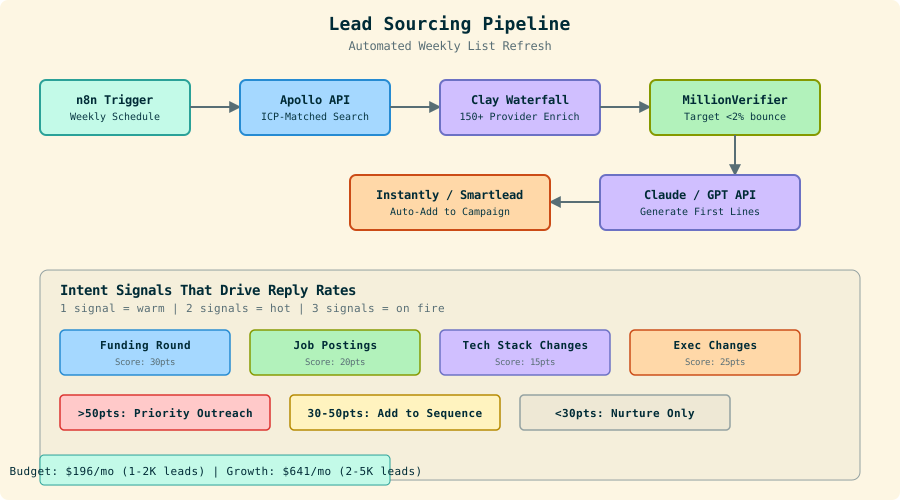
Manual list building does not scale past the first few campaigns. The following n8n pipeline automates the entire flow from ICP search to campaign launch. It runs weekly, keeping your lists fresh and your bounce rates low.
Base Tier Pipeline
Growth Tier Pipeline (Adds Clay Enrichment)
The growth tier inserts Clay between the Apollo search and verification steps. This adds waterfall enrichment and AI-generated personalized first lines.
Practitioner-Reported Bounce Rates
Marketing materials from data providers always overstate accuracy. The numbers below come from cold outbound practitioners, agency operators, and community discussions — not vendor landing pages. These are the bounce rates people actually experience in production campaigns.
Real-World Bounce Rates by Data Source
| Data Source | Reported Bounce Rate | With Secondary Verification | Notes |
|---|---|---|---|
| Apollo.io (raw export) | 12-20% | 2-5% | Catch-all domains are the main culprit |
| ZoomInfo | 3-8% | 1-3% | Best raw accuracy, but 10-30x the cost |
| Clay (waterfall + verify) | 5-10% | 2-4% | Quality depends on waterfall configuration |
| Lusha | 10-15% | 3-6% | Stronger for phone data than email |
| RocketReach | 10-20% | 4-8% | Large database but many pattern-guessed emails |
The pattern is clear: no data provider is accurate enough to send to directly. Even ZoomInfo, at $15,000+/year, benefits from secondary verification. The verification step is non-negotiable at every tier and every budget level.
Recommended Tool Stacks
Two proven configurations based on budget and volume. The Budget stack gets you running for under $200/month. The Growth stack adds enrichment orchestration and higher sending capacity for teams doing 2,000-5,000 leads per month.
- Apollo.io Basic $49/mo
- MillionVerifier $30/mo
- LinkedIn Sales Navigator $80/mo
- Instantly Growth $37/mo
- Clay Growth $495/mo
- Apollo.io Basic $49/mo
- Instantly Hypergrowth $97/mo
- n8n (self-hosted) $0/mo
Lead Sourcing Architecture
The following diagram shows the complete lead sourcing flow from ICP definition through verified list delivery. Data flows left to right: define your ICP, query data providers, enrich through Clay's waterfall, verify through a dedicated service, and push clean leads to your sending platform.
Lead Sourcing Approaches — Scalability Analysis
There are fundamentally different approaches to building prospect lists. Each has different scale characteristics, data quality profiles, and cost structures. Understanding the trade-offs helps you choose the right approach for your current stage — and plan the transition to the next stage.
1. Manual LinkedIn Research
Open LinkedIn Sales Navigator, manually search for prospects matching your ICP, review each profile, and hand-pick the best fits. Copy their information into a spreadsheet or CRM.
2. Apollo Batch Export
Use Apollo's search filters to find prospects matching your ICP, then export batches of hundreds or thousands of contacts at once. Can be done manually through the UI or automated via Apollo's API.
3. Clay Waterfall Enrichment
Start with a list of companies or contacts, then run them through Clay's waterfall enrichment — querying multiple data providers in sequence until complete data is found. Add AI-generated personalization on top.
4. Web Scraping (Phantombuster / Apify)
Use automation tools to scrape LinkedIn profiles, company websites, directories, and industry databases. Extract contact information, company details, and other data points programmatically.
5. Intent-Based Targeting
Instead of targeting static ICP attributes (title, company size, industry), target prospects who are exhibiting active buying signals: recent funding, relevant job postings, tech stack changes, executive turnover, or website visits.
6. Referral and Network-Based Sourcing
Leverage existing customers, partners, and professional network to get warm introductions to prospects. Ask satisfied clients for referrals, tap into LinkedIn connections, and use mutual relationships to bypass the cold outreach entirely.
7. Purchased Lists
Buying pre-built email lists from data brokers or list vendors who sell bulk contact databases, often by industry or job title.
Approach Comparison Summary
Sourcing Approach Comparison
| Approach | Scale | Data Quality | Cost | Verdict |
|---|---|---|---|---|
| Manual LinkedIn | 10-20/hr | Highest | $80-100/mo | ICP validation only |
| Apollo batch export | 1000s/week | Moderate | $49/mo | Start here |
| Clay waterfall | 1000s/week | High | $149-800/mo | Growth stage |
| Web scraping | High (limited) | Varies | $69-170/mo | Niche use cases |
| Intent-based targeting | Moderate | High (targeting) | $29-400/mo | Always layer this in |
| Referral/network | Low | Perfect | Time only | Always pursue |
| Purchased lists | Instant | Catastrophic | $0.05-0.50/lead | Never |
Key Takeaways
- No single data provider is sufficient. Plan for a primary source (Apollo) plus secondary verification (MillionVerifier) at minimum. Add Clay for waterfall enrichment at the growth stage.
- Always verify before sending. Secondary verification is non-negotiable at every budget level. Target under 2% bounce rate on every campaign.
- Intent signals are a multiplier. Layer intent scoring on top of any sourcing method to prioritize prospects in active buying windows. Reply rates increase 2-5x.
- Automate list refresh. Build an n8n pipeline that runs weekly, pulling fresh leads through your enrichment and verification stack automatically.
- Start budget, graduate to growth. Prove the model with Apollo + MillionVerifier + Instantly ($196/mo) before investing in Clay and higher-volume infrastructure.
- Never buy lists. Purchased lists destroy domain reputation, trigger spam traps, and create legal liability. There is no shortcut to building clean, verified prospect data.